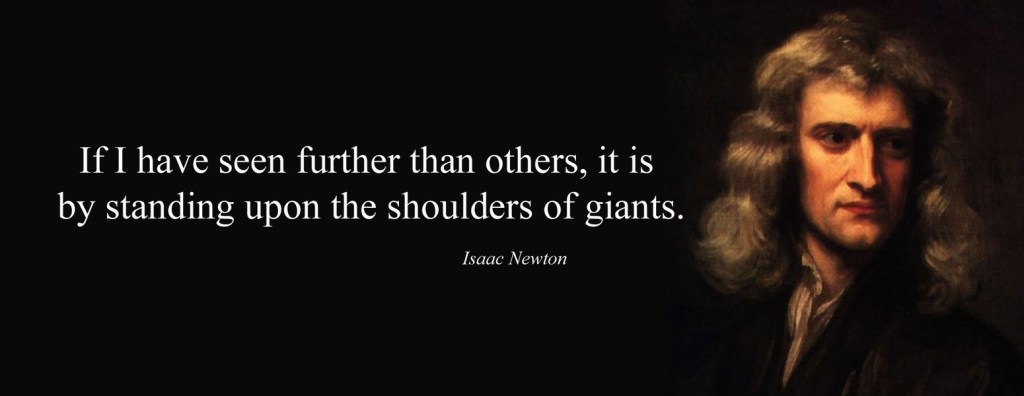
The famous statement made by Isaac Newton in a letter to Robert Hooke goes something like this: “If I have seen further it is by standing on the shoulders of Giants”. It is ironic in some way, coming from an intellectual giant himself; at least it is a clear statement of humility. I always think about this statement in relation to Atlas: the titan punished to hold up the earth on his shoulder, also considered a wiseman and the father of astronomy. Astronomy, also interesting the field that Isaac Newton contributed too (amongst others).
We should all recognize that the world we enjoy and thrive in was created by giants, and we rest on their shoulders; whether it be the inventors of certain technologies, like Nikola Tesla or Fredrick Banting, or political giants like Churchill or the founding fathers: our world today is as comfortable as it is due to the genius of others. The iterative nature of invention and intellectual progress is obvious, for without previous ground being covered, we could not extend to where we are today. The progress and genius of one is the fertile ground of progress for another.
We stand on the shoulders not just of intellectual or political greatness, but also on the shoulders of the everyday courageous folk. We seem to discount this sort of greatness more so than the more obvious intellectual or political genius, for the inventions and discoveries of these people are right in our hands, whether it be our phones or insulin. Ruth Hubbard in “Science, Facts and Feminism” discusses the nature of science as a social enterprise. But a social enterprise that “is made, by and large, by a self-perpetuating, self-reflexive group by the chosen and for the chosen” (Hubbard 6). This group largely discounts non-traditional ways of generating scientific knowledge – like gardening, or working in the home – something that Hubbard argues against: “I am suggesting that we acknowledge the scientific value of many of the facts and knowledge that women have accumulated and passed on in our homes and in volunteer organizations”(14). The problem with this group of scientists is that they only see the Giants. This hegemonic ivory tower of scientists discount these everyday soldiers of courage, the lab technicians, the janitorial staff, the many women in important yet unfairly respected roles: all of these people who contribute to the enterprise of science and knowledge creation, yet are not recognized for that contribution. These individuals are the ones who do a large portion of the scientific labor, yet receive little of the scientific credit. Just like these scientists in their ivory tower, we too do not see the giants of the everyday: the courageous folk, who despite it all row away to keep our collective ship afloat.
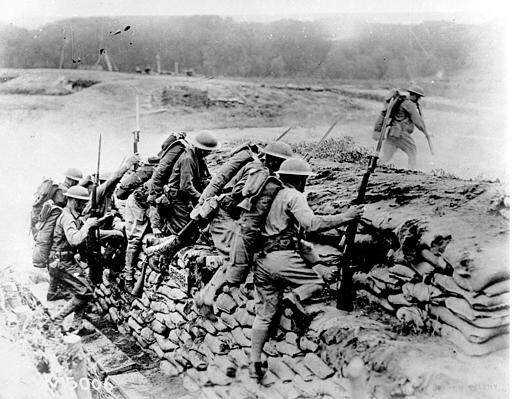
These individuals are especially discounted in the long ark of history. The shoulders of giants that I feel I stand on, are the shoulders of everyday soldiers; not Churchill and the genius commanders and politicians of World War I and II – but the foot soldiers, the first people over the trench who ran straight through no mans land and right into enemy fire. For yes, these political greats helped secure the world order we have today, but without these courageous individuals their political dreams could not have been manifested, realized, brought down into reality from the dreams of genius. Just like the lab techs, who help collaborate in many ways to generate our scientific understanding; these everyday individuals are the people who hold the giants and their massive shoulders up so that we may comfortably and unreflectively rest upon them. Instead of us standing on the shoulders of giants, we stand upon shoulders of giants whom themselves rest upon the collective hands of the many, the everyday courageous folk.
And I find that today, these are the folk we need more then giants. Our problems of climate change will not be solved by the intellectual genius of one, or the political prowess of a few. Instead, the collective, everyday, courageous individuals are the ones who will toil the fertile land of the possible future. For it is not a dream or an idea we need; we all know what we desire, what we need, what the future must look like; every parent knows what future they want for their child and every child knows what future they want to grow up in. Instead, what our culture requires is those courageous foot soldiers, those honourable many who recognized the sacredness of their sacrifice: that the work of the one is for the security of the many. That that trench cannot be taken unless some people are killed in fire. Soldiers know this, and so do everyday folk who keep this magnificent system afloat: that their act, though just a cog in the wheel of the machine, their act alone is what keeps the machine running. It is this belief in the sacredness of individual sacrifice that will save us all, not genius, not intellectual or political greatness.
Today, instead of our society resting on the shoulders of giants, the whole of life on earth rests in our hands. It is as if Prometheus, the one who holds the stolen flame, now aims it at the Tree of Life. Every animal, from dog to elephant, every organism, from cell to bacteria, every person, from peasant to president, every desire and dream, every possible future and experience – these all are within our collective palms. We must not hope for giants to be our savior, for Atlas cannot hold us and the world up – we need to take our share of the responsibility. If we are to see a future that is not barbaric, that is what we all dream of for ourselves and our children, it will arise because we everyday folk find that same courage of those who climbed over the trench; that courage which is deep within our psyche, our soul, our spirit: can you feel it? If we are to manifest the future we all dream of we must together go “over the top”; climb over the trench of fear, and run straight into dangerous territory, together, towards the common enemy: our patient inaction.
 Chris Milne Writes: Poetry, Philosophy and Essays
Leave a comment